

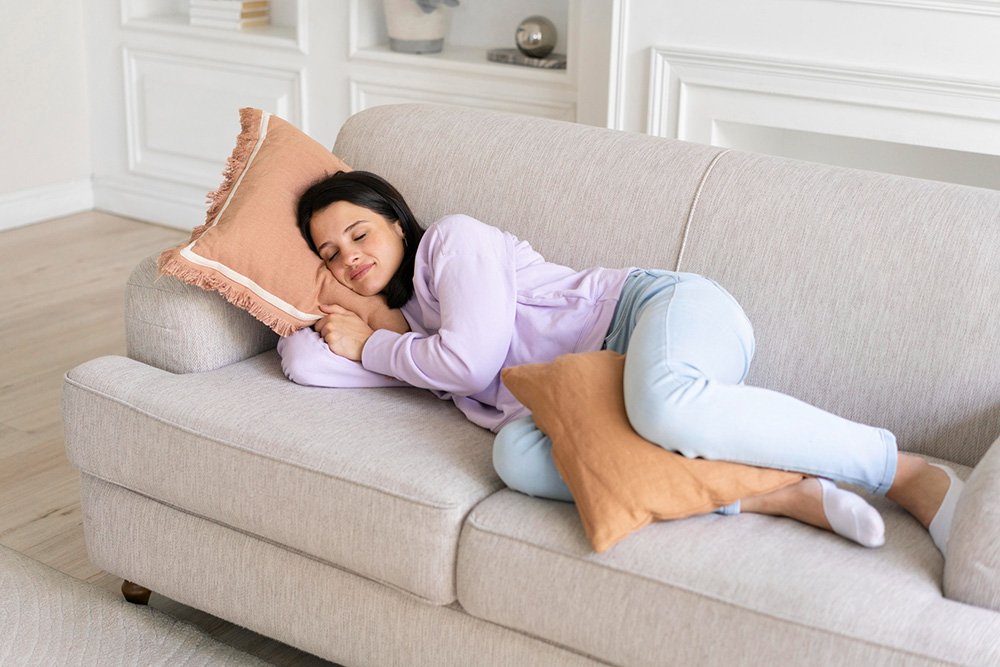
The quickest way to understand this sleep tip is to lie on your side and notice where your top knee goes when you stop holding it in place. It might drop forward until it touches the mattress. It might rest directly on the other knee, leaving two bony spots pressed together. Or it might settle comfortably without any help at all. When I think about why you’d sleep with a pillow between your legs, that’s where I start. The pillow gives the upper leg somewhere to rest. Whether that makes a difference depends on what the leg was doing before you put the pillow there.
For some side sleepers, the immediate benefit is cushioning between the knees. For others, supporting the upper leg makes the hip or lower back feel less pulled into a twist. Mayo Clinic includes a pillow between slightly bent legs among its suggestions for making side sleeping more comfortable with back pain. But that’s a positioning suggestion, not a treatment for the cause of back pain. If you already sleep comfortably, there’s no need to add a pillow just to make your posture look more like a diagram.
I’ll explain how to tell whether you need cushioning at the knees, support all the way down to the ankles, or a different setup entirely. I’ll also cover what the research can and can’t tell us, where pregnancy-related pelvic pain changes the conversation, and which three Amazon options I’d compare if an ordinary pillow works but won’t stay where you need it. I’d test the idea with bedding you already own before buying anything.
What a Pillow Between Your Legs Actually Does
When you lie on your side, your lower leg rests on the mattress. Your upper leg has fewer places to go. It may settle onto the lower leg, slide forward, or end up partly supported by the bed while the rest of you still faces sideways. There’s nothing inherently wrong with moving into those positions. The question is whether the way your leg settles leaves you comfortable. If the top knee drops forward and you feel a pull through the hip or lower back, putting something beneath that leg can change the position enough to make it easier to rest.
I think of the pillow first as a resting place for the upper leg, not as a device that pushes the spine into alignment. That distinction affects how I’d choose its thickness. A cushion that fills the space between relaxed legs gives you support. One that raises the top thigh well above where it would comfortably sit may feel like it’s prying the legs apart. The right amount of support often feels uneventful. You can let the weight of your leg settle, and there’s no urge to squeeze the pillow or shift away from it.
The second job is simpler. A pillow can keep the inner knees or ankles from pressing against each other. If direct contact is the main source of discomfort, you may only need a thin layer of cushioning rather than a firm spacer. This is a useful distinction because a product marketed for back or hip support might be much thicker than you want. I’d rather buy for the actual problem than put up with a bulky shape because the packaging suggests firmer support is better.
I’d also distinguish between the upper hip and the hip against the mattress. A pillow between the legs can change where the upper leg rests. It doesn’t take your body weight off the lower hip. If the sore spot is the one you’re lying directly on, try the other side, if comfortable, and see what happens before adding more height between your knees. Cambridge University Hospitals makes a similar distinction in its guidance for gluteal tendinopathy. It suggests avoiding direct pressure on the sore side and using a pillow to support the legs in side lying.
Between the Knees, Down to the Ankles, or Under the Legs?
“Put a pillow between your legs” sounds specific until you’re actually on the bed deciding where it goes. A small cushion at the knees feels different from a bed pillow that reaches the lower shins. A body pillow changes more than leg position because it also gives the top arm somewhere to land. And once you roll onto your back, the same cushion may be more useful under the knees than between them. I’d choose the smallest setup that solves the discomfort you can actually identify.
| Setup | When I’d try it | Where I’d place the support | What would make me switch |
|---|---|---|---|
| Thin pillow between the knees | Your knees press together, but the hips and feet already feel comfortable. | Between the inner knees or slightly above them, wherever it cushions contact without forcing the legs wide. | It flattens completely, slips away, or leaves a seam pressing against a tender spot. |
| Bed pillow between the knees and lower legs | The knees feel better with support, but the top shin or ankle still drops forward or presses into the lower leg. | Lengthwise between the legs, letting it reach as far down as you comfortably need. | It’s too bulky to turn with, or it lifts the whole top leg higher than you want. |
| A pillow in front of you under the top leg | You naturally sleep slightly rolled forward and don’t enjoy holding the knees directly one above the other. | In front of the body, supporting the upper knee and enough of the lower leg that you don’t have to hold it up. | You feel more twisted than before or have to curl tightly to keep the leg on the pillow. |
| A full-length body pillow | You want to rest the top arm as well as the top leg, or a shorter pillow keeps shifting out of reach. | In front of the torso, with the lower part available for the knee and shin to rest on. | It crowds the bed, feels too warm, or makes ordinary position changes feel like work. |
| A pillow under both knees | You mostly sleep on your back or want a comfortable alternative to lying on your side. | Across the bed beneath both knees, with a modest lift rather than a high stack. | It pushes sharply behind the knees or makes your legs feel stuck in one position. |
The distinction between knee and ankle support is one I’d check in practice rather than through a measurement. If a small spacer makes both legs feel comfortable, there’s no reason to trade it for a long pillow. If your top knee rests well but the lower leg feels unsupported, try extending the cushion before increasing its height. More length and more thickness solve different problems. One carries the support farther down the leg. The other changes how far apart the legs rest.
I’d also leave room for a position somewhere between lying fully on your side and rolling forward. Some people don’t like the feeling of stacking their knees and shoulders. They may be more comfortable resting the top leg on a pillow slightly in front of them. I wouldn’t force a different posture just because a product is shaped for it. If supporting the leg in your normal position works better than trying to hold another one, that’s the more useful setup.
Who Might Notice the Biggest Difference?
Side sleepers with lower-back discomfort
If I were waking with an achy lower back and regularly finding myself with one knee thrown across the bed, I’d try supporting the top leg. It’s an inexpensive way to see whether that position contributes to how I feel. The result I’d look for is practical. Does the lower back feel more relaxed before sleep? Do I feel less need to keep rolling around? When I wake up, is getting out of bed any easier? None of that requires the pillow to stay in place until morning or the body to spend the entire night on one side.
I wouldn’t assume that back pain is caused by sleep position just because I notice it on waking. The previous day’s activities, a flare of an existing problem, and an interrupted night can all affect what the morning feels like. The pillow experiment tells you something narrower and more useful. It can show whether one position feels better supported than another. If the back ache is the same whatever you do in bed and is becoming more limiting during the day, I’d stop making the bedding carry the whole explanation.
People who dislike pressure on the outer hip or inner knee
Outer-hip discomfort can be tricky because both sides of a sleep setup can matter. Lying on the sore side applies direct pressure. Lying on the other side without supporting the top leg may still be uncomfortable if that leg drops toward the mattress. For someone already advised that they have gluteal tendinopathy, a pillow between the knees is one of the adjustments Cambridge University Hospitals suggests. But I wouldn’t use this response as a test for what’s causing hip pain. Other conditions can produce symptoms around the same area, and persistent pain deserves a proper assessment.
For inner-knee contact, I’d start even more simply. If the knees feel fine when they’re not touching, a thin pillow or folded layer of bedding may be enough. Try to notice whether the discomfort comes from contact with the other knee or from the position of the knee itself. If one pillow takes away the pressure of bone against bone but introduces an uncomfortable bend or puts a firm edge against the joint, it’s a bad exchange. I’d try a softer or broader cushion before spending money on one that promises more support.
Pregnant sleepers with pelvic girdle discomfort
During pregnancy, the most useful pillow may be the one that makes a particular movement or position easier, not necessarily the largest one you can fit on the bed. The Royal College of Obstetricians and Gynaecologists includes a pillow between the legs and support beneath the bump among its suggestions for pregnancy-related pelvic girdle pain. Those are separate points of support. You can try them with separate pillows if you already have them and adjust one without changing the other. If a single long pillow feels easier to manage, that is a matter of comfort and convenience, not a requirement.
If rolling over, climbing stairs, or getting in and out of the car is painful, I’d mention those details to a midwife or clinician rather than assuming that discomfort is unavoidable. They help describe the impact and can guide an assessment, which may include referral to a physiotherapist. And if your maternity team has given you individual sleep-position advice, that takes priority over general suggestions about where to put cushions. The purpose of the pillow is to make a recommended or comfortable position easier to use, not to replace professional guidance.
What the Evidence Supports and What It Doesn’t
There’s a difference between a clinician recommending a simple change for comfort and a clinical trial showing that a specific product treats pain. The guidance I find most useful comes from Mayo Clinic, which suggests a pillow between the legs for side sleeping with back discomfort, and from specialist sources that suggest similar positioning in particular circumstances. These recommendations are specific enough to try without spending much money, but they don’t identify a universally best material, pillow height, or number of hours to use it.
A BMJ Open scoping review offers a useful reality check. It looked at how studies had examined sleep posture and nonspecific spinal symptoms in adults. Only four studies met the authors’ criteria, and all relied at least in part on people reporting their own sleep position. The review found preliminary associations, but there weren’t enough high-quality studies to answer the question confidently. It didn’t establish that putting a particular pillow between the legs prevents or treats lower-back pain. That’s one reason I’m more comfortable recommending a small trial at home than declaring one sleeping posture medically superior for everyone.
I’d also treat claims about curing sciatica, correcting the spine, or improving circulation differently from claims about keeping the knees apart. You can see and feel whether a pillow prevents your knees from touching. That doesn’t demonstrate a change in circulation or tell you whether a spinal nerve is less compressed. Someone with shooting leg pain may find one sleeping position more tolerable, but that’s relief in a position, not proof that the nerve problem has been treated. The modest claim is also the one that’s easiest to evaluate honestly. Does it help you rest more comfortably tonight, and can you repeat the result without creating a different problem?
How I’d Try It at Home Without Buying a Pillow
I’d begin on the side I normally choose, with my usual pillow under my head, and give myself a moment to settle before changing anything. If I put a spare pillow between my legs too quickly, I don’t get a good sense of what it’s replacing. I’d notice where the upper knee and ankle land, where I feel pressure, and whether I’m already fairly comfortable. Then I’d try the spare pillow near the knees with the legs gently bent. There’s no need to pull them into a tight curl or hold them in a position that feels unfamiliar.
- Change the placement before you add more height. If the knees feel good but the top ankle keeps dropping or rubbing, turn the pillow lengthwise to bring some support farther down. If the upper hip feels lifted or the cushion crowds the inner thighs, try something thinner. I’d adjust one thing at a time so I can tell whether it was the thickness, length, or position that helped.
- Judge the setup when you turn over, not just while you lie still. Bring the pillow into the position you normally use and see how easy it is to release or move. If you wake up looking for it but feel no worse without it, that might mean it’s only useful while you settle. If you repeatedly wake up because it’s in the way, choose a simpler setup or stop using it. There’s no benefit to preserving an arrangement that costs you sleep.
- Check for a pattern across ordinary nights. I’d compare how comfortable I am at bedtime, whether I wake to move the pillow, and how I feel when I get up. One particularly good or bad night doesn’t tell me much. If a setup makes things worse, I’d take it away rather than waiting for my body to adjust. If the same small change keeps helping, I have a much better idea of what to look for in a dedicated pillow.
A detail I’d pay attention to is whether the pillow feels right only when it’s freshly fluffed. Fiber fill can compress after you settle, especially if you’re using a soft head pillow as a spacer. If it works at first but soon flattens, you may need something that holds its shape better. If the ordinary pillow remains comfortable and reasonably easy to move, you’ve already solved the problem. A specialized pillow earns its place when it fixes a drawback you can name, not simply because it’s marketed for side sleepers.
How Products Can Help: Three Amazon Pillows I’d Compare
These are three products to look up by name on Amazon, chosen for different reasons. The compact Contour pillow makes sense if you want shaped support without an attachment. The Everlasting Comfort model is worth comparing if a loose pillow keeps sliding away. The Coop body pillow serves a different purpose because it can support the top arm as well as the leg. I’d use an ordinary-pillow trial to decide between them. That’s more useful than treating the three as competing treatments for the same pain.
- Contour Legacy Leg & Knee Pillow — for compact support without a strap. This memory foam pillow has a tapered shape and a removable, washable cover. I’d consider it if an ordinary pillow gives you the right idea but takes up more of the bed than you want. The shape is designed to fit between the legs, with less bulk toward the tapered edges. Because it has a fixed profile, I’d check whether the amount of separation makes sense for you. If you prefer just a thin cushion between the knees, even a compact foam pillow may feel too substantial. On the other hand, a strap-free design is appealing if you want to be able to move away from the pillow easily or pull it back into place without unfastening anything.
- Everlasting Comfort Memory Foam Knee Pillow with Adjustable Strap — for a spacer that tends to slide away. The useful feature here is the adjustable, removable strap on the version that includes it. I’d look at this model if you already know you like a compact knee pillow but regularly lose it when you reposition. The strap is intended to help keep the cushion with a leg, but it shouldn’t feel tight or restrict movement. If you dislike the feeling of something around your leg, try the pillow without the strap or choose a strap-free design. I’d also check the exact listing because size and configuration can vary. This is a purchase for easier positioning, not a reason to tolerate a wedge that feels too thick when it stays put.
- Coop Sleep Goods Original Adjustable Body Pillow — for support beyond the knees. At 20 by 54 inches, this is a much larger commitment of bed space, but the size is exactly what makes it useful if you want to rest your arm and upper leg on the same cushion. The foam-and-microfiber fill can be added or removed. I’d consider it if a short spacer leaves the shin or ankle looking for somewhere to land, or if you already sleep with one pillow between your legs and another to hug. The tradeoff is bulk. If you share a smaller bed, sleep warm, or turn frequently, a long pillow can be harder to manage. Measure how much space you’re willing to give it before choosing it for the extra coverage alone.
For all three, I’d check the thickness where your leg will actually rest, not just the largest dimension in the photo. I’d also look at whether the cover can be washed separately and whether the seller accepts opened bedding returns. These details affect how well a pillow fits into your life. A supportive shape won’t make you happy if it’s impossible to clean easily or if you spend the night maneuvering around it. And if you’re recovering from surgery and were told to use a particular pillow or wedge, follow those instructions instead of substituting a retail sleep cushion.
When a Pillow Isn’t the Next Step
I wouldn’t keep rearranging the bed if pain is getting worse, repeatedly interrupting sleep, or limiting ordinary activities such as walking or getting dressed. It helps to tell a clinician what you notice in bed, but also what happens when you’re up and moving. A pain that settles when you change position is different from discomfort that no position seems to relieve. If back pain starts suddenly and severely, worsens rapidly, or comes with fever or feeling generally unwell, seek urgent medical advice rather than continuing a pillow experiment.
Seek emergency care if back pain comes with new trouble urinating or controlling your bladder or bowels, new numbness around the genitals or anus, or new weakness or numbness in both legs. Those symptoms need assessment even if moving around or lying a certain way briefly feels better. A pillow can make it easier to rest, but it can’t tell you what’s causing a new symptom or whether it’s safe to wait.
My Take on Sleeping With a Pillow Between Your Legs
The reason I’d sleep with a pillow between my legs is straightforward. It can give the upper leg a more comfortable place to land and stop the knees from pressing together. I’d start with the spare pillow in the cupboard, move it farther down if the ankles need support, and make it thinner if the hips feel pushed apart. If I mostly wake up on my back and that position is more comfortable with a little knee bend, I’d try the pillow underneath both knees instead. Where it goes matters more than what it’s called.
I’d buy a dedicated pillow only when it addresses something the spare one doesn’t. Maybe I need a compact shape that’s easier to move, a strap I can remove, or more length to rest the top leg and arm together. If the ordinary pillow does the job, I’d keep it. A worthwhile sleep setup shouldn’t have to look impressive. It should let you settle without constantly thinking about where to put your legs.
Medical Disclaimer
This article provides general educational information about sleep positioning and pillows for adults. It does not diagnose or treat back, hip, knee, or pelvic pain, and the products mentioned are comfort aids rather than medical treatments. Follow any individual positioning instructions from your pregnancy care team, surgeon, or physiotherapist. Seek medical advice for persistent or worsening symptoms and emergency care for new bladder or bowel changes, saddle-area numbness, or weakness or numbness in both legs alongside back pain.
References
- Mayo Clinic Staff. Sleeping Positions That Reduce Back Pain. This clinical resource explains how support placement differs between side and back sleeping. It provides the basis for trying a pillow between slightly bent legs or underneath both knees, depending on the position.
https://www.mayoclinic.org/diseases-conditions/back-pain/in-depth/sleeping-positions/art-20546852 - Cary D, Briffa K, and McKenna L. Identifying Relationships Between Sleep Posture and Non-Specific Spinal Symptoms in Adults: A Scoping Review. Published in BMJ Open, this review summarizes research on sleep posture and spinal symptoms. It explains why early findings can inform a comfort experiment without establishing that one pillow or position is best for everyone.
https://pubmed.ncbi.nlm.nih.gov/31256029/ - Cambridge University Hospitals NHS Foundation Trust. Gluteal Tendinopathy. This physiotherapy resource explains how different resting positions affect compression around the outer hip. Its advice distinguishes lying on a sore hip from supporting the upper leg when lying on the opposite side.
https://www.cuh.nhs.uk/patient-information/gluteal-tendinopathy/ - Royal College of Obstetricians and Gynaecologists. Pelvic Girdle Pain and Pregnancy. This patient resource covers pregnancy-related pelvic girdle pain, when to ask for an assessment, and ways to make resting and turning in bed more comfortable. It includes support between the legs and beneath the bump.
https://www.rcog.org.uk/for-the-public/browse-our-patient-information/pelvic-girdle-pain-and-pregnancy/ - National Health Service. Back Pain. This clinical guidance distinguishes self-care from symptoms that require routine, urgent, or emergency evaluation. It supports the article’s advice on when to stop troubleshooting bedding and seek care.
https://www.nhs.uk/conditions/back-pain/