

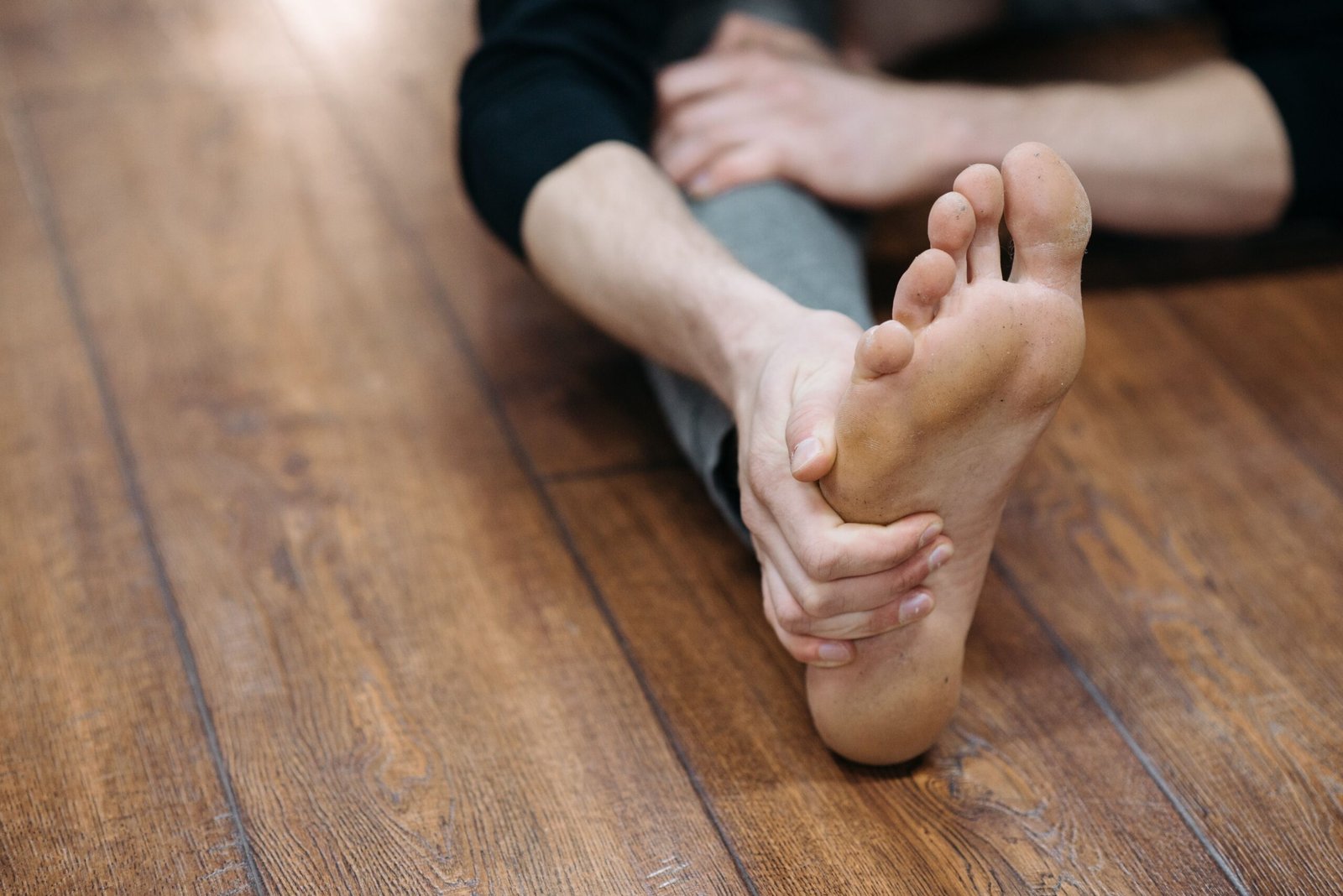
A burning feeling in both feet is hard to ignore. A loss of feeling can be easier to miss. You might not realize anything has changed until a sock leaves a mark you never felt, you catch your toe on the same step twice, or you notice that walking across a dark room feels less steady than it used to. Those experiences sound unrelated, but they can all be clues to a problem with the peripheral nerves.
When I explain polyneuropathy symptoms, I start with the pattern rather than the sensation. Tingling, burning, and numbness are useful words, but they’re only the beginning. Where did the change start? Did it happen on both sides? Has it crept up gradually, or did your strength change over a few days? The answers help distinguish a common slow-moving form of polyneuropathy from a pinched nerve, a spinal problem, or a condition that needs urgent care. [1, 2]
The most familiar pattern begins in the toes and affects both feet, but it isn’t the only one. In this guide, I’ll explain how sensory changes, weakness, balance problems, and less familiar symptoms can show up in everyday life. I’ll also cover what an evaluation can tell you and which practical products may make daily tasks easier. If weakness is getting worse quickly, you suddenly can’t walk safely, or you’re having trouble breathing or swallowing, seek emergency medical care now. Those symptoms should not wait for a routine appointment. [1]
What Polyneuropathy Is and Why It Often Starts in the Feet
Your peripheral nerves carry messages between the brain and spinal cord and the rest of your body. Some carry information about touch, heat, or pain. Others tell your muscles to move. Still others help regulate functions you don’t consciously control, such as sweating, digestion, and changes in blood pressure when you stand. Polyneuropathy means that multiple peripheral nerves are affected, rather than a single nerve being compressed or injured in one place. Which fibers are involved determines much of what you notice. [1, 2]
The most common form is called distal symmetric polyneuropathy. The word distal means far from the center of the body, and symmetric means that the changes generally affect both sides in a similar way. In this form, the longest nerve fibers tend to be affected first. That’s why a person might notice tingling in the tips of both big toes long before anything changes in the fingers. As symptoms spread, they may move across the feet and up toward the ankles or calves. If the hands become involved later, the distribution is often called a stocking-and-glove pattern. [1]
That pattern is a clue, not a rule every person has to fit. A person with polyneuropathy doesn’t necessarily have hand symptoms, and symptoms don’t always progress to the same extent. Other forms can start more abruptly, affect one side more than the other, or cause weakness that stands out before numbness does. I wouldn’t dismiss those differences because they’re less typical. A new problem lifting one foot, for example, is more important to describe accurately than to force into a familiar explanation. [1]
Early Sensory Symptoms Can Feel Like Too Much or Too Little
Tingling, burning, and electric pain
One way people describe early sensory symptoms is that their feet feel as though they’re waking up after going to sleep, except they weren’t sitting on them and the sensation keeps returning. Others describe burning soles, prickling toes, or brief shocks that interrupt whatever they’re doing. There can also be an unusual mismatch between the feeling and what you see. A foot feels hot, but the skin doesn’t feel especially warm to the touch. A bedsheet that would normally go unnoticed becomes uncomfortable. Pain from a normally harmless touch is called allodynia. [1, 2]
I’d pay attention to whether the sensation keeps coming back in the same places. A leg that tingles for a minute after you’ve been sitting on it is a different story from tingling in both sets of toes most evenings for several weeks. Some people notice nerve pain most at night, when it can interfere with falling or staying asleep. That timing alone doesn’t establish the cause. What’s more helpful is describing the location, what triggers it, how long it lasts, and whether there’s numbness or weakness in the same area. [1, 2]
Numbness and a weaker sense of temperature
Numbness doesn’t always feel like complete absence of sensation. It may feel as though you’re wearing socks when you’re barefoot, or as though the floor feels less distinct through one part of the foot. Some people notice they can no longer judge heat and cold as reliably. Others discover a blister, cut, or spot of irritation when changing socks rather than feeling it happen. A foot that hurts less isn’t necessarily a foot that’s functioning better, particularly if you’re also losing the ability to notice pressure, temperature, or injury. [2, 3]
Pain and loss of sensation can exist together. It’s possible for the same toes to burn at night and still fail to register a small object inside a shoe. This is one of the parts of neuropathy people find most confusing, but it makes sense once you know that abnormal pain signals and reduced protective sensation aren’t opposites. I’d report both changes rather than describing the problem only as painful or only as numb. Each has different consequences for how you sleep, walk, and look after your feet. [1–3]
Weakness, Balance Problems, and Changes You Notice While Walking
Balance doesn’t depend solely on muscle strength. Your brain also uses information from your nerves to work out where your feet and ankles are without having to look at them. That awareness is called proprioception, or position sense. If the signals become less reliable, you may start watching your feet on the stairs or feel less confident on uneven ground. A well-lit room may feel manageable, while the same room in the dark feels surprisingly difficult to cross because you can’t rely on your eyesight to compensate. [1, 2]
Muscle weakness is a different problem, although it can develop alongside sensory loss. I’d listen for the physical task that has changed. Are your toes catching because it’s hard to lift the front of your foot? Are you having trouble walking on your heels, or does one foot slap down more noticeably than it used to? In the hands, it might be harder to manage buttons or hold objects that used to feel secure. These details tell a clinician more than a general report that your legs feel tired or your hands feel awkward. [1, 2]
Foot drop means difficulty lifting the front of the foot. It can occur with polyneuropathy, but it can also come from a problem affecting a single nerve or a nerve root in the back. A new foot drop, especially on one side, is a reason to seek urgent assessment. I wouldn’t assume it’s just another stage of foot numbness. The same goes for repeated falls or a clear decline in strength. Those changes deserve attention even if the pain itself is mild or hasn’t changed. [1]
Autonomic Symptoms That Don’t Look Like a Nerve Problem
Autonomic nerves help coordinate some of the body’s background work. When they’re affected, a person might feel lightheaded after standing, sweat notably more or less than before, or develop changes in digestion, bladder function, or sexual function. For example, someone might feel unusually full after a small meal or find that standing up repeatedly brings on a gray, dizzy feeling that improves when sitting back down. None of those symptoms sounds much like burning toes, but they can belong in the same medical history. [1, 2]
The catch is that autonomic symptoms are rarely specific to neuropathy. Lightheadedness can be related to dehydration, medication, or many other conditions. Constipation is common for reasons that have nothing to do with peripheral nerves. I wouldn’t put every symptom under a neuropathy label just because several appeared around the same time. I would tell the clinician which changes began together, what makes them worse, and whether they arrived alongside numbness, weakness, or balance trouble. That gives the clinician a chance to look for a shared cause without overlooking a separate problem. [1, 2]
A Side-by-Side Look at Common Symptom Patterns
The most helpful distinction I’ve found is between what you feel, what you no longer feel, and what you can no longer do as easily. Burning belongs in the first category. Missing the heat of bathwater belongs in the second. Catching your toes because you can’t lift the front of your foot belongs in the third. The table puts those differences in everyday terms. It’s a way to organize what you’ve noticed, not a checklist for making a diagnosis at home. [1–3]
| Symptom pattern | How it may show up in everyday life | What I’d tell a clinician |
|---|---|---|
| Painful sensory changes | Burning soles, prickling in the toes, electric pains, or discomfort from socks or a bedsheet | Where it started, whether it feels similar on both sides, and whether touch or rest changes it |
| Reduced protective sensation | Missing a blister, not noticing a pebble in a shoe, or having trouble judging how warm water is | Which areas are numb and whether you’ve had a cut, burn, or pressure mark you didn’t feel |
| Reduced position sense | Watching your feet on steps, walking less confidently in the dark, or feeling unsteady on uneven ground | Where you feel most unsteady and whether there have been falls or near-falls |
| Muscle weakness | Catching your toes, finding it harder to lift the front of a foot, or struggling with buttons and small objects | Which task changed first, whether one side is worse, and how quickly strength has changed |
| Possible autonomic changes | Lightheadedness on standing, unusual sweating, or new digestive, bladder, or sexual symptoms | Whether these began near the time of other symptoms and whether medicines or doses changed |
| Focal or rapidly changing symptoms | One foot suddenly becomes difficult to lift, or weakness spreads over hours or days | When it started and how quickly it’s getting worse. Seek urgent assessment rather than waiting to see if the pattern becomes clearer |
My favorite way to put this into practice is to replace a broad description with an example. Instead of saying, “My balance is off,” try “I’m steady in daylight, but I started holding the wall on the way to the bathroom at night.” Instead of “My feet are numb,” try “Both big toes started tingling, and now the balls of both feet feel padded when I walk barefoot.” Those aren’t diagnostic statements. They’re useful observations that can guide an exam. [1, 2]
Why the Same Symptoms Can Have Different Causes
Diabetes is a common cause of polyneuropathy, particularly when the symptoms build gradually and begin in both feet. But having diabetes doesn’t automatically explain every new nerve symptom. Someone with diabetes can also have a pinched nerve, a vitamin deficiency, a reaction to a medication, or an unrelated neurological condition. If a person’s symptoms are clearly one-sided, have progressed rapidly, or are mainly about weakness rather than sensory change, those details can change what should be investigated. [1]
Beyond diabetes, clinicians may consider vitamin B12 deficiency, chronic kidney disease, long-term heavy alcohol exposure, certain medicines including some chemotherapy drugs, inherited conditions, and immune-mediated disorders. There’s a practical reason to look beyond the initial label. Correcting a deficiency is a different decision from managing a side effect or treating an inflammatory disorder. If chemotherapy or another prescription might be involved, I’d contact the prescribing team promptly rather than pause it on my own. The timing of the symptoms can help that team weigh the benefits and risks of any change. [1, 2]
Supplements belong on the medication list too. Too much supplemental vitamin B6 can itself cause peripheral neuropathy, and it can be easy to overlook how much you’re getting when it’s included in several products. Someone may take a multivitamin, a B-complex, and a product marketed for energy or nerve support without realizing they share an ingredient. If I were preparing for a visit, I’d photograph the labels or bring the bottles. I wouldn’t buy another nerve supplement simply because tingling sounds like a vitamin problem. Vitamin B12 deficiency and excess supplemental vitamin B6 are different issues and shouldn’t be treated as interchangeable. [1, 4]
Sometimes no cause is found after an appropriate evaluation. You may hear the word idiopathic, which means the cause hasn’t been identified, not that the symptoms aren’t real. There’s still value in addressing sleep disruption, reducing the chance of foot injuries, or getting help with a changing gait. It also helps to know which developments should bring you back sooner, such as new weakness or a change that no longer fits the original pattern. [1]
When to Make an Appointment and When to Get Help Sooner
For gradually developing tingling or numbness that keeps returning, I’d book a medical appointment. I’d do the same if sensations are spreading up both feet, disrupting sleep, or making it harder to walk confidently. There’s no need to wait for symptoms to become painful before bringing them up. In fact, painless sensory loss can be particularly easy to underestimate because it offers so little warning when a shoe is rubbing or a foot is injured. [1–3]
Weakness that is clearly getting worse over hours or days calls for emergency evaluation, particularly if it is spreading up the legs, making it difficult to stand or walk, or occurring with trouble breathing or swallowing. A serious condition such as Guillain–Barré syndrome is one possible cause of rapidly progressive weakness, and it can affect the muscles involved in breathing. Conversely, a new, isolated foot drop or a marked change on one side still deserves urgent assessment even if you can get around. The broader point is that speed and loss of function matter more for urgency than whether the symptoms feel like tingling or burning. [1]
A foot injury is a separate reason to act. If you have diabetes or reduced protective sensation and find an open sore, signs of infection, or a foot that’s newly warm, red, or swollen, contact a healthcare professional promptly. Don’t judge a foot problem by how much it hurts when you already know sensation is reduced. If you have a history of foot ulcers or circulation problems, ask your care team which changes should trigger a same-day call and who to contact. Having that plan in advance is more useful than deciding what to do only after you spot a problem. [3]
How Clinicians Evaluate Polyneuropathy Symptoms
An evaluation usually starts with the same questions I’ve emphasized throughout this guide. A clinician will ask when the changes began, where they started, how they spread, and what’s happening to strength and balance. The exam may include checking reflexes, muscle strength, and how you sense vibration, touch, or other stimuli. It may also involve watching you walk. The aim is to see whether the findings line up with a disorder affecting multiple peripheral nerves, or point somewhere else. A familiar symptom on its own can’t settle that. [1, 2]
What I’d bring to the appointment
- A brief symptom timeline. Write down the first place you noticed the change and approximately when it started. Add whether the other side changed around the same time, whether the symptoms spread, and whether something new has happened in the past few days or weeks. A short, specific note is more useful than trying to reconstruct everything in the exam room.
- Examples of tasks that changed. Note whether you’ve tripped, needed the stair rail more often, struggled to fasten buttons, or found a foot injury that you didn’t feel. If the pain affects sleep, describe what happens on a typical night. These examples give the clinician a clearer picture of how the problem affects your day.
- A list of medicines, supplements, and relevant health history. Include prescription and nonprescription products, along with their doses if you can find them. Mention recent illnesses, changes in medication, diabetes, kidney disease, past chemotherapy, or any family history of nerve or walking problems you know about. Labels or photos are fine if the ingredients are hard to recall. [1, 4]
Blood tests are often selected to look for common and potentially treatable causes. Depending on your symptoms and history, a clinician may check blood sugar, vitamin B12, kidney function, or other markers. They may also use a test called serum protein electrophoresis to look for abnormal patterns in certain blood proteins. I wouldn’t read a typical list of tests as a shopping list to order on your own. The exam and the pattern of symptoms help determine which tests are worth doing and how the results should be interpreted. [1]
Nerve conduction studies and electromyography, often called EMG, can help identify the kind of nerve problem and distinguish it from some conditions that look similar. However, these tests don’t directly assess the smallest sensory fibers. Someone with a small-fiber neuropathy can have burning pain or altered temperature sensation and still have normal routine nerve conduction results. In a suitable case, a specialist may consider other tests, such as a skin biopsy or autonomic testing. A normal result doesn’t automatically settle the question in either direction. It needs to be interpreted alongside the symptoms and exam. [1, 2]
How Three Practical Amazon Products Can Help With Daily Tasks
The products I’d look at first address problems that nerve symptoms can create around the house. A mirror helps you see a part of your foot that may no longer reliably signal an injury. Socks might make shoes more comfortable if the cuff of an ordinary pair digs in. A night light makes the route to the bathroom easier to see if you rely more heavily on vision for balance. None of these products repairs nerves or treats the cause of polyneuropathy. Each is worth considering only if it solves a specific problem you’re actually having. The products below are listed on Amazon, although availability may vary.
- General Tools 80560 Telescoping LED Inspection Mirror — for seeing the soles of your feet. This is a general-purpose mirror with an extendable handle, an adjustable head, and built-in lighting. Its most useful job here is straightforward. It can help you check the heel and sole without twisting awkwardly or trying to balance on one leg. I’d use it while sitting in a sturdy chair, with enough room light to see changes in skin color. Look for rubbing, blisters, cuts, or a new spot under a callus, and ask for help if you can’t get a clear view. A hand mirror you already own is just as reasonable if it lets you see the whole area. The benefit comes from making the inspection easier to do, not from buying a particular model. [3]
- Dr. Scholl’s Diabetic & Circulatory Non-Binding Ankle Socks — for comfort around the ankle. I’d consider this style if the cuff of a regular sock leaves a pronounced mark or feels too tight. The non-binding top is a comfort feature, not evidence that the socks improve circulation or restore sensation. Fit matters at both ends of the foot. Make sure the sock stays in place, doesn’t bunch under the toes, and doesn’t take up so much room that the shoe feels tighter. If you have reduced sensation, check your skin after the first few wears rather than relying on discomfort to tell you something is rubbing. These aren’t medical compression garments or a substitute for prescribed footwear. If swelling or circulation is a concern, ask a clinician what type of sock is suitable. [3]
- GE UltraBrite Motion-Activated LED Night Light, Model 12201 — for the route from bed to bathroom. This plug-in light can be useful if you’re noticeably less steady in the dark or if the main switch is across the room. I’d place it so it lights the first part of the route before you reach a threshold, rug edge, or other change underfoot. Test the position with the room lights off while you’re safely standing still or with someone nearby. If the sensor turns on too late or leaves a stretch of the walkway dark, a bedside lamp or a continuously lit fixture may work better for that space. Lighting is one part of the setup. It can’t correct weakness or make up for loose rugs, clutter, or an unsafe stairway. [5]
If I were choosing between the three, I’d put my money toward the task I’m currently struggling to do. If I can’t see my heels, I’d solve that before buying specialty socks. If I’ve started reaching for the wall at night, I’d clear the walking route and improve the lighting, but I’d still bring the balance change up at an appointment. A product is most useful when it makes a sensible habit easier. It shouldn’t become a reason to wait on a symptom that needs evaluation. [1, 3, 5]
What Improving Symptoms Can Realistically Look Like
I find it helpful to separate treating the cause, reducing pain, and making everyday life safer. They’re related goals, but they don’t always move at the same pace. Treating an identified cause may prevent further nerve injury or allow some recovery, depending on what started the problem and how long it’s been present. A pain treatment may make it easier to sleep or get through a workday without restoring normal sensation. Physical therapy can focus on strength and walking, while foot care can address the practical risks that come with reduced feeling. [1–3]
That distinction makes it easier to notice meaningful changes. If the burning eases but you still can’t feel a blister forming, keep up the foot checks. If walking feels more stable but you still catch the same toe on steps, mention it rather than assuming the problem has resolved. And if a medicine helps you sleep but makes you feel groggy or unsteady the next morning, both outcomes belong in the conversation with the prescriber. The goal is a plan that improves the parts of life the condition is affecting, not just a lower number on a pain scale. [1–3]
At home, I’d pay particular attention to direct heat if sensation is reduced. A heating pad or hot-water bottle can be tempting when the feet feel strange or cold, but numb skin may not warn you before a burn. I’d also ask about footwear if pressure marks keep appearing, and get help with any spots that are difficult to inspect. These changes may sound modest, but they address the problems people can actually prevent while the cause and treatment are being sorted out. [3]
My Takeaway on Polyneuropathy Symptoms
If there’s one thing I’d take away, it’s that the pattern is more informative than any single symptom. Tingling in both sets of toes that gradually spreads is a different story from sudden weakness in one foot. Burning and numbness can coexist, and unsteadiness in the dark can reveal a sensory change that was easy to miss in daylight. The most useful details are where the symptoms started, how quickly they’ve changed, and what you can no longer feel or do as easily.
For persistent symptoms, I’d write down those details, make an appointment, and bring a list of medicines and supplements. While waiting, I’d protect numb feet, make it easier to see where I’m walking, and take any new injury seriously. For rapidly worsening weakness, a sudden inability to walk safely, or trouble breathing or swallowing, I wouldn’t wait for a scheduled visit. The same phrase, “my feet feel different,” can describe situations with very different levels of urgency. What happened next is often the most useful part to tell. [1–3]
References
- Mirian A, Aljohani Z, Grushka D, and Florendo-Cumbermack A, CMAJ. Diagnosis and Management of Patients With Polyneuropathy. A peer-reviewed clinical review covering typical and atypical presentations, urgent referral signs, diagnostic testing, and management.
https://pmc.ncbi.nlm.nih.gov/articles/PMC9928442/ - National Institute of Neurological Disorders and Stroke. Peripheral Neuropathy. An NIH overview explaining peripheral nerve function, the effects of sensory, motor, and autonomic nerve damage, and approaches to diagnosis.
https://www.ninds.nih.gov/health-information/disorders/peripheral-neuropathy - National Institute of Diabetes and Digestive and Kidney Diseases. Diabetes & Foot Problems. Evidence-based patient guidance on foot checks, footwear, reduced protective sensation, and signs that a foot problem needs medical attention.
https://www.niddk.nih.gov/health-information/diabetes/overview/preventing-problems/foot-problems - Therapeutic Goods Administration. Peripheral Neuropathy With Supplementary Vitamin B6 (Pyridoxine). A regulatory safety review explaining the link between supplemental vitamin B6 and neuropathy, including reports involving multiple products.
https://www.tga.gov.au/news/safety-updates/peripheral-neuropathy-supplementary-vitamin-b6-pyridoxine - National Institute on Aging. Preventing Falls at Home, Room by Room. NIH guidance on improving lighting, clearing walking routes, and addressing common household fall hazards.
https://www.nia.nih.gov/health/falls-and-falls-prevention/preventing-falls-home-room-room
Disclaimer
This article is for general education and does not replace a diagnosis, neurological examination, or treatment plan from a qualified healthcare professional. The products mentioned are examples of everyday aids, not treatments for nerve damage or substitutes for prescribed footwear, mobility support, or wound care. Seek medical advice for persistent or progressive numbness, pain, weakness, or balance changes. Seek emergency care for rapidly worsening weakness, sudden inability to walk safely, or new difficulty breathing or swallowing.