

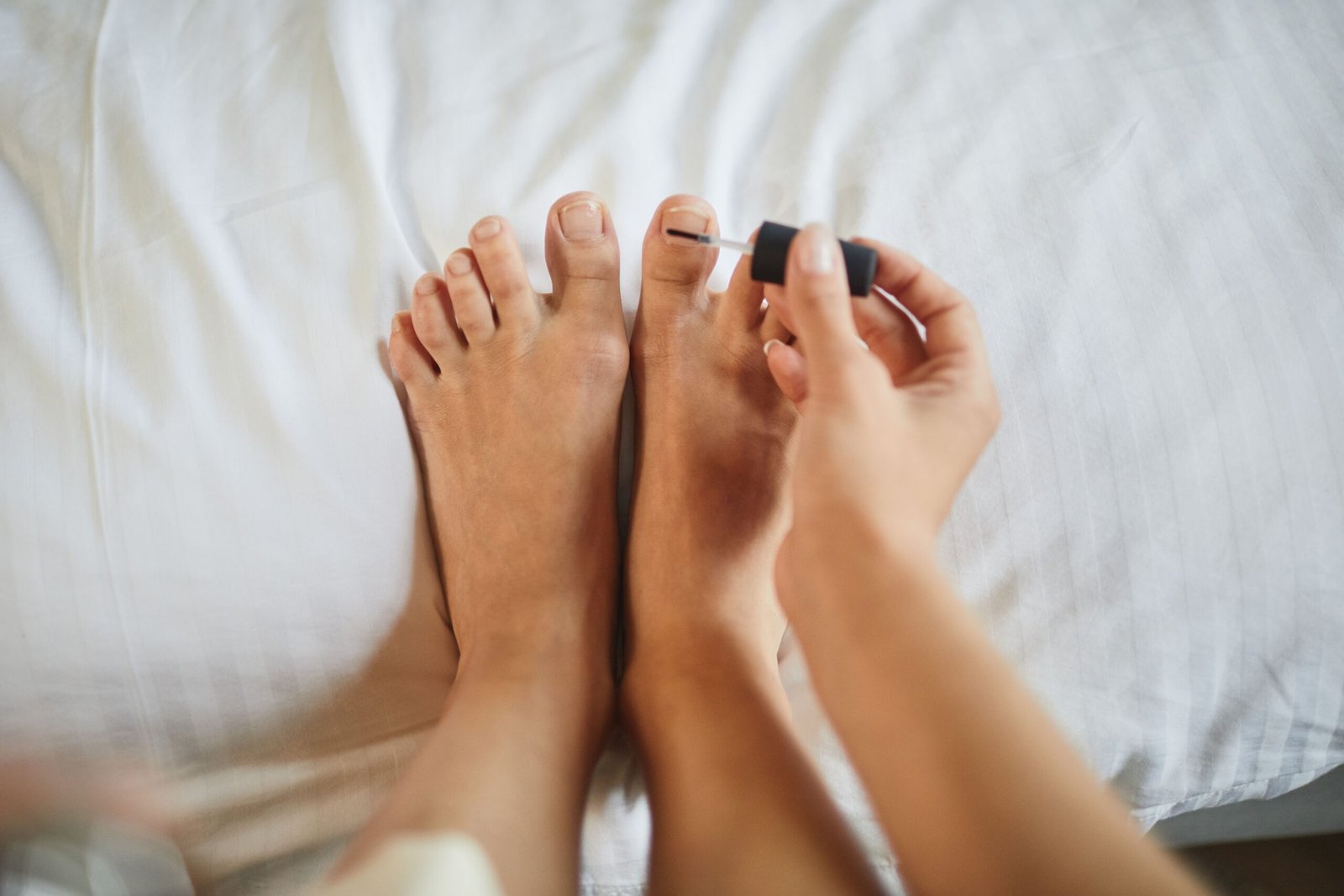
A yellow corner on a big toenail is easy to ignore. It doesn’t hurt, it’s usually hidden under a sock, and there are plenty of explanations that seem more plausible than an infection. Maybe your shoes rubbed on a long walk. Maybe you dropped something on your toe and forgot about it. Then the corner gets thicker, the edge starts catching on your socks, and the clippers that work on every other nail suddenly aren’t up to the job. That’s when most people start looking up toenail fungus.
Onychomycosis is a fungal infection of a toenail or fingernail. It can cause discoloration, thickening, crumbling, or separation of the nail from the skin underneath. Toenails are affected more often than fingernails, and the changes tend to develop slowly. Still, I wouldn’t call a nail fungal just because it’s yellow or thick. Repeated shoe pressure, psoriasis, and other nail conditions can produce a similar appearance, and the treatment that works for a fungal infection won’t fix those other causes.
The distinction I keep coming back to is that clearing the infection and growing out the damaged nail are two different milestones. You can finish a course of treatment and still see an ugly patch at the tip for months. You can also file a nail until it looks better without clearing the infection at all. In this guide, I’ll explain how clinicians tell the difference, what the treatment options actually involve, and where supplements fit if you’re considering one for general nail support.
What onychomycosis does to a nail
The hard part you trim is the nail plate. It rests on the nail bed, and new nail forms from an area called the matrix, mostly hidden beneath the skin at the base. In the most common type of onychomycosis, the infection begins near the tip or along one side and gradually works farther under the nail. Early on, you might see little more than an off-color corner. As the infection spreads, the edge can turn brittle, debris can build up underneath, and the plate may lift away from the bed.
Most cases involve dermatophytes, a group of fungi that can live on keratin, the structural protein found in nails and the outer layer of skin. Certain yeasts and molds can also cause nail infections. That difference matters when the pattern is unusual or treatment hasn’t worked as expected. Finding a mold in a sample, for example, doesn’t necessarily mean it caused the nail damage. A clinician may need to match the lab result to what they see on examination or use a second test to clarify it.
Not every fungal nail follows the yellow-corner pattern. A superficial infection can leave chalky white patches on the nail surface, while a less common pattern starts closer to the cuticle. I’d pay more attention to where the change began and how it’s moving than to the precise shade of yellow or white. A patch that started at the tip and has gradually spread inward tells a different story from a mark that appeared overnight after you banged your toe. Neither observation settles the diagnosis, but both are useful at an appointment.
What nail fungus looks like and what can look just like it
A fungal toenail may have a rough edge that breaks away when you trim it instead of clipping cleanly. You might notice a thicker patch under one side or a pale area where the nail has lifted. But even a very typical-looking nail can have more than one thing going on. Someone who runs downhill in shoes that are too short might have repeated nail damage and a fungal infection in the same toe. The injury story doesn’t rule out fungus, and finding fungus doesn’t mean shoe pressure is irrelevant.
Nail psoriasis is another good example. It can cause tiny pits, lifting, thickening, and yellow-orange discoloration beneath the nail. Those clues are useful, especially if you already have psoriasis elsewhere, but nail psoriasis and fungus can coexist. I find the comparison below more helpful as a way to describe what you see than as a way to diagnose yourself. The goal is to decide what deserves checking, not to match your toenail to the first photo that looks familiar.
| Possible cause | What you might notice | What I’d bring up at an appointment |
|---|---|---|
| Onychomycosis | A slowly spreading yellow or white patch near the tip or side, with crumbling, thickening, or material collecting underneath. | When the change started, whether it has reached other nails, and whether the skin between the toes is itchy or peeling. |
| Repeated pressure or an injury | A thickened, lifted, or bruised nail on a toe that rubs against footwear. A bruise from an injury generally moves toward the tip as the nail grows. | New boots, running mileage, a particular impact, or a dark patch that isn’t moving outward as expected. |
| Nail psoriasis | Tiny pits, an orange-yellow patch beneath the nail, lifting, or similar changes in more than one nail. | Any history of psoriasis and whether testing could check for fungus at the same time. |
| A pigmented nail lesion | A new or changing brown or black band, particularly if it widens, looks irregular, bleeds, or extends onto the surrounding skin. | When the band first appeared and how it has changed. I’d arrange prompt evaluation rather than trying an antifungal first. |
A new, unexplained, or changing dark band is the finding I wouldn’t leave to a months-long trial of a fungus product. Dark bands have several possible causes, and many are not cancer. The point of getting one assessed is to rule out important alternatives, including nail melanoma, rather than deciding what it is from a photograph. If you already have a dated picture showing how the band looked before, bring it. If you don’t, there’s no reason to wait and build a photo record before making the appointment.
How you get onychomycosis and who is more likely to develop it
One thing I’d take out of the conversation immediately is the idea that nail fungus is a sign of poor hygiene. The fungi involved can spread in places such as communal showers and changing rooms. They can also spread from your own skin to a nail when you have athlete’s foot. Wearing sweaty shoes for long stretches or repeatedly knocking your toes against tight footwear can add to the problem. None of that means a person with a fungal nail has failed to wash their feet properly.
Athlete’s foot and nail fungus are related, but they’re not interchangeable. Athlete’s foot affects the skin, often causing peeling, cracking, or itching between the toes. Onychomycosis affects the nail unit, where the infection is harder to reach. A cream that clears irritated skin between your toes isn’t necessarily formulated to penetrate a thick nail. If you have both problems, I’d mention both when seeking advice. It’s easy to focus on the nail because it’s more noticeable, but the skin infection may help explain how it started or why it returned.
Older adults are more likely to develop fungal nail infections. Slower nail growth, years of minor trauma, and other health conditions can all contribute. Diabetes, poor circulation, and a weakened immune system are also relevant, not only because of infection risk but because they change what’s safe to tackle at home. If you have reduced feeling in your feet, for instance, you may not notice a cut caused by trying to thin a thick nail yourself. In that situation, I’d put more emphasis on safe foot care than on making the nail look better quickly.
How a clinician confirms a fungal nail infection
A useful evaluation starts with the story rather than the lab. When did the change appear? Did the discoloration begin at the base or at the tip? Has the nail lifted, started to hurt in shoes, or changed since you began using a product? A clinician can use those details alongside an examination of the nail and nearby skin. They may also use a dermatoscope, a handheld magnifying instrument, to pick up patterns that aren’t obvious at a glance. An exam can narrow the possibilities, but on its own it may not be enough to confirm fungus.
A clinician can take a clipping or collect material from beneath the affected part of the nail. One common test uses potassium hydroxide, often shortened to KOH, to make fungal structures easier to see under a microscope. A fungal culture takes longer but can help identify the organism. Other options include staining a clipping to look for fungal structures within it or using PCR to detect fungal genetic material. The best choice depends partly on what the clinician needs to learn and what testing is available locally.
A negative test doesn’t always close the case. Where the sample was taken matters, as does whether you’ve already used an antifungal. If the result doesn’t fit the appearance, a clinician may repeat the sample, use a different test, or investigate another cause. I’d bring the name of anything I’d already tried, even if it was a pharmacy cream or a home remedy. Confirming fungus is especially important before taking an oral antifungal, because tablets can have side effects and interactions and won’t correct a nail change caused solely by injury or psoriasis.
What actually treats onychomycosis
When the infection is limited to a small area near the nail tip and hasn’t reached the part that makes new nail, a clinician may offer a topical antifungal formulated for nails. Depending on the country, options can include ciclopirox, efinaconazole, tavaborole, or amorolfine. The practical advantage is that topical medicines generally have fewer drug interactions than oral antifungals. The trade-off is time and, on average, a lower likelihood of cure. Several prescription toenail treatments are applied for about 48 weeks, making the routine itself an important part of the decision.
If the infection affects several nails, covers much of a nail, or reaches closer to the base, oral treatment may make more sense. Terbinafine is a common first choice for confirmed dermatophyte nail infections in adults who can safely take it. In the United States, a typical toenail course is around 12 weeks, though local guidance and individual treatment plans can differ. A prescriber reviews your medications and liver health and generally checks baseline liver function before prescribing oral terbinafine. Itraconazole is another option in selected cases, but it brings different interactions and safety considerations.
Professional trimming or thinning, called debridement, can take pressure off a thick nail and may be used alongside antifungal medicine. I’d distinguish that relief from curing the infection. The same distinction applies to lasers marketed for a clearer-looking nail. Some devices are cleared in the United States for a temporary increase in clear nail, which isn’t the same as demonstrating that the fungus is gone. And while remedies such as tea tree oil have been studied on a small scale, I wouldn’t put them in the same category as established antifungal treatments. For some otherwise healthy people with mild disease and low risk of complications, discussing a decision not to treat is also reasonable.
How I’d tell whether the nail is improving
If I were monitoring treatment, I’d look first at the base of the nail, not the part I can clip. Since that’s where new nail comes from, a strip of clearer growth near the cuticle can be more informative than the color at the tip. As the nail grows, the older damaged part should gradually move outward. Looking at it every morning rarely helps. A photo every month, taken from roughly the same angle and in similar lighting, gives you a better basis for comparison than your memory of how yellow it looked two weeks ago.
A big toenail can take a year or longer to grow out, and some toenails take up to about 18 months to regrow fully. That’s why a 12-week course of tablets and a year of visible recovery aren’t contradictory. The medicine addresses the infection. The nail still has to replace the damaged portion. Some nails won’t return to their former appearance if another problem, such as longstanding shoe trauma, also affected normal growth. I wouldn’t take an imperfect-looking nail as automatic proof that the fungus is still there.
If you’re comparing results online, watch for the difference between mycologic cure and complete cure. Mycologic cure generally refers to negative fungal testing under the study’s criteria. Complete cure usually requires both negative tests and a clear-looking nail. A product can sound more effective simply because the headline cites the more easily achieved outcome. At home, a photo can document what’s changing, but it can’t tell you whether fungus remains. If the clear area stops getting wider or a new patch starts spreading again, a follow-up is more useful than trying to work out which kind of cure you achieved.
Can supplements help with onychomycosis?
The strongest reason I can see to consider a supplement is a separate, identified nutrition need. For instance, if a clinician determines that a deficiency is contributing to brittle nails, correcting it may help with the changes caused by that deficiency. That’s different from taking a supplement to get rid of a fungus living in a nail. A single toenail that’s turning yellow, thickening, or lifting doesn’t tell you which nutrient you need. More importantly, no dietary supplement has an established role as a replacement for antifungal treatment for onychomycosis.
Biotin is the ingredient I’d look at most carefully because it appears in so many hair, skin, and nail products. The NIH Office of Dietary Supplements notes that the studies often cited for brittle nails were small and lacked placebo groups. Their findings don’t establish that biotin clears toenail fungus. High supplemental doses can also interfere with certain blood tests, including some thyroid tests and some troponin tests used to evaluate a possible heart attack. Tell your clinician and the lab if you take biotin, including as part of a beauty blend or multivitamin.
If you’re browsing Amazon for general nail support, I’d compare products by what they actually contain. The three examples below represent different options rather than three versions of the same pill. I’m not ranking them as fungus treatments or suggesting they’ll improve the results of an antifungal. What makes the comparison useful is that a high-dose vitamin, an animal-derived protein powder, and a multi-ingredient tablet bring different considerations. The first question I’d ask about any of them is what specific need it would address.
- Nature’s Bounty Biotin 5,000 mcg Softgels. This is a single-ingredient option centered on vitamin B7, so it’s straightforward to check whether you’re already getting the same ingredient from another supplement. It’s also a high-dose formula. I wouldn’t choose it just because the number on the front is bigger, and I’d make sure to disclose the dose before blood tests.
- Vital Proteins Collagen Peptides Powder Advanced, Unflavored. This bovine collagen powder is an alternative format for someone who prefers stirring a supplement into a drink to taking another capsule. Check the exact version if you’re comparing ingredients across listings, and skip it if you avoid bovine ingredients. I’d treat it as a general nutrition product, not an oral treatment for an infected nail.
- Solgar Skin, Nails & Hair Advanced MSM Formula. This tablet combines MSM with nutrients including vitamin C, zinc, and copper. The broader ingredient list is the main difference from a standalone biotin softgel or collagen powder. If you already take a multivitamin, I’d compare the labels first to see which nutrients you’d be doubling up on.
How to reduce the chances of nail fungus returning
An infection can come back after treatment. Sometimes the original infection wasn’t fully cleared. In other cases, the nail is exposed again, for example through untreated athlete’s foot or contaminated footwear. You usually can’t tell the difference just by looking. I’d also keep in mind that thickening after treatment doesn’t always mean the fungus is back. If you go straight to another course without checking, you could miss the simpler explanation that the nail never stopped rubbing against the front of a shoe.
The habits I’d prioritize are the ones you can keep doing after the nail stops demanding your attention. Dry between your toes after washing. Change socks if they stay damp through the day, and give shoes time to dry before wearing them again. Wear sandals in communal showers or changing rooms, and choose footwear that leaves enough room for your longest toe, especially during long walks or runs. These steps can reduce exposure and repeated injury, but they don’t guarantee that an infection will never recur.
I’d also keep clippers and files personal, clean them after use, and avoid digging under a lifted edge. It’s tempting to scrape out everything you can see, but aggressive trimming can injure the skin and make a simple situation harder to manage. If you have persistent peeling or cracking between the toes, ask about athlete’s foot so it doesn’t go untreated while you focus on the nail. For recurrent, confirmed infections, it’s worth asking a clinician what might be keeping the cycle going before buying another product.
When I’d get a changing nail checked
For one slowly thickening nail that isn’t painful and doesn’t have a suspicious dark mark, a routine visit is a reasonable starting point. I’d be more inclined to book if the change is spreading, the nail is getting harder to trim, or other nails are starting to look similar. I’d also mention if the toe hurts only when it’s inside a shoe. Pain while walking or exercising is easy to overlook in an exam room, but it can be the main reason the problem matters to you.
I wouldn’t wait for pain if I had diabetes, reduced sensation, poor circulation, or a weakened immune system. With reduced sensation, discomfort isn’t a reliable warning that you’ve injured your toe while cutting the nail. An open sore, pus, spreading redness, warmth, swelling, or fever calls for urgent medical advice, especially in someone with diabetes or a weakened immune system. Those symptoms go beyond what I’d expect from an uncomplicated, slowly changing fungal nail and can indicate a different or additional problem.
I’d approach a suspicious dark band differently from a thick, yellow patch. If I noticed a band that was new, widening, irregular, or extending onto the skin beside the nail, I’d say that clearly when booking the visit rather than calling it “possible toenail fungus.” The wording matters because you want the change assessed for what it is, not filed under a diagnosis you made at home. Mention when you first noticed it and bring any older photos you already have.
My bottom line on onychomycosis
What is onychomycosis in everyday terms? It’s a fungal infection of the nail, not another name for a discolored toenail. That distinction can spare you a long stretch of treating the wrong thing. I’d start by noticing where the change began, how quickly it’s moving, and whether there’s anything else going on with the surrounding skin or the other nails. Those details are a better starting point than trying to diagnose a problem from color alone.
Once the cause is clear, the treatment decision becomes much more practical. A limited infection may suit a topical medicine, while a more extensive one may warrant a discussion about tablets. The right choice also has to account for your health, your other medications, and what you can realistically stick with. After treatment starts, I’d watch the newer nail at the base rather than expecting the older nail at the tip to change overnight. The nail grows on its own schedule, even when the medicine has done its job.
As for supplements, I’d only spend money on one if I could name the separate nutrition problem I was trying to solve. A bottle marketed for better-looking nails doesn’t tell you whether the nail is infected, and it doesn’t help you choose between treating fungus, changing your footwear, or investigating a skin condition. The most useful first step for a persistent nail change is to find out what’s causing it. That gives you something an encouraging label can’t offer: a realistic idea of what to do next and how you’ll know if it’s working.
Disclaimer
This article is for general education and is not a diagnosis or a treatment plan. A qualified healthcare professional can examine the affected nail, look for other causes, and determine whether testing or treatment is appropriate.
Antifungal medicines differ in their availability, side effects, and drug interactions. Discuss your health history, including liver disease, pregnancy or breastfeeding, and your current medicines and supplements with a clinician or pharmacist before starting treatment.
The supplements named in this article are examples of products marketed for general wellness or nail support. They are not treatments for onychomycosis. Seek medical assessment for a suspicious nail change or signs of a foot infection rather than relying on a supplement or home remedy.
References
- Falotico JM and Lipner SR. Updated Perspectives on the Diagnosis and Management of Onychomycosis. This peer-reviewed dermatology review explains the different patterns of fungal nail disease, what each diagnostic test can establish, and how oral, topical, and device-based treatments compare.
https://pmc.ncbi.nlm.nih.gov/articles/PMC9484770/ - British Association of Dermatologists. British Association of Dermatologists Guideline for Managing Fungal Nail Infection (Onychomycosis) 2026. This evidence-based clinical guideline supports the discussion of when topical treatment, oral treatment, or observation may be appropriate and how decisions change for people at higher risk of complications.
https://doi.org/10.1093/bjd/ljag318 - Frazier WT, Santiago-Delgado ZM, and Stupka KC II. Onychomycosis: Rapid Evidence Review. This review in American Family Physician summarizes the evidence for common antifungals, typical treatment courses, realistic regrowth timelines, and measures that may reduce recurrence.
https://www.aafp.org/afp/2021/1000/p359 - National Institutes of Health, Office of Dietary Supplements. Biotin: Fact Sheet for Health Professionals. This resource explains the limitations of the available studies on biotin for brittle nails and documents how supplemental biotin can interfere with some laboratory tests.
https://ods.od.nih.gov/factsheets/Biotin-HealthProfessional/ - American Family Physician. Nail Abnormalities. This clinical review explains how trauma, psoriasis, and other nonfungal conditions can change nail color or shape. It also describes features of pigmented nail bands that warrant further evaluation.
https://www.aafp.org/afp/2025/1000/nail-abnormalities